Orchard Machinery Servicing
Orchard machinery operates in punishing conditions: high engine load cycles at crawling ground speeds, fine particulate dust during dry summer canopy sweeps, and dense chemical mists that test every seal, filter, and electronic connector. Here is how we approach comprehensive servicing routines.
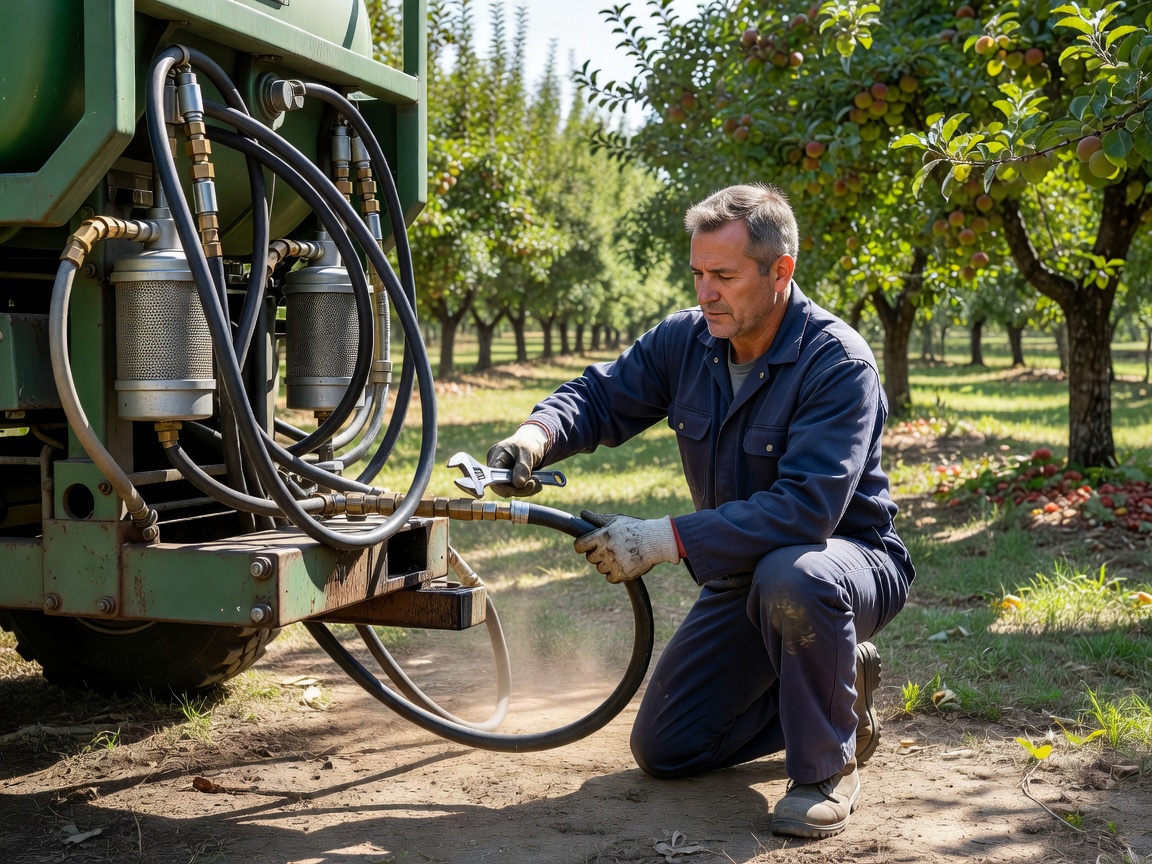
Engine, Filtration & Powertrain Servicing Focus
Narrow-track tractors and trailed implement gearboxes face continuous torsional vibrations. A thorough service schedule must extend beyond basic engine oil flushes to incorporate planetary drive seals, PTO driveline joints, and hydrostatic loop cleanliness.
Why Orchard Machinery Demands Distinct Servicing Rules
If you run standard open-field arable tractors, your machines generally benefit from wide open headlands, consistent airflow through high-mounted radiators, and relatively straight, uninterrupted passes. Orchard tractors and implements experience the opposite.
To navigate high-density apple, pear, or olive groves, orchard tractors feature compact wheelbases, low hood profiles, and narrow chassis widths ranging from 1.0 to 1.5 meters. This dense packaging means hydraulic oil reservoirs are smaller, resulting in higher fluid turnover rates and increased thermal stress. Cooling packages operate under intense strain because leaf debris and blossom fluff settle directly into radiator fins. When servicing these units, the cooling matrix and auxiliary coolers require just as much attention as the crankcase oil.
Core Mechanical Service Components
Every comprehensive orchard service routine should address six primary mechanical subsystems:
1. Lubrication & Grease Packing
Orchard pivots, steering tie rods, three-point hitch linkages, and implement universal joints must be purged with high-load, water-resistant lithium complex grease. Special care must be given to constant-velocity PTO shafts that operate at extreme angles during tight headland turns between trellised rows.
2. Engine Filtration & Crankcase Oil
Air filters in orchard environments clog rapidly from powdery soil and chemical deposits. Servicing includes inspecting the cyclonic pre-cleaner, changing secondary safety elements according to operational hours, and using low-ash oils formulated to handle tight thermal bounds during low-speed, high-PTO-torque applications.
3. Belts, Pulleys & Alternator Tensioners
Serpentine belts driving water pumps, high-output alternators, and air-conditioning compressors suffer accelerated wear under cyclic load spikes. Technicians must check belt deflection, bearing play on idler pulleys, and inspect ribbed surfaces for ozone micro-cracking and chemical degradation.
4. Bearings & Flail Rotor Balance
On inter-row flail mowers and shredders, outer rotor bearings encounter immense lateral load and stone strikes. Routine service checks verify axial play, bearing temperature profiles using infrared sensors, and grease seal integrity to prevent soil intrusion.
5. Hydraulic Pumps, Valves & Couplers
Orchard tractors rely heavily on electro-hydraulic proportional valves to drive tree-pruning saws, mast lifts, and steering offset cylinders. Servicing involves testing relief valve cracking pressures, replacing return-line micro-filters, and checking quick-release hydraulic couplers for weeping seals that can leak onto delicate root zones.
6. Electrical Connections & Sensor Wiring
Corrosion is common due to repeated exposure to copper sprays and sulfur-based fungicides. All wiring harness grommets, cab pressure switches, flow meters, and solenoid valves must be inspected for corrosion, cleaned with contact cleaner, and resealed with dielectric silicone grease.
Common Planning Mistakes in Grower Workshops
The most frequent error is treating servicing as a spring-only activity. When spray rigs or tractors sit idle over winter with degraded fluids containing acid buildup and moisture, internal bearings etch and corrosion sets in before the first blossom pass.
Another frequent issue is ignoring hydraulic oil changes while merely swapping the spin-on filter. Degraded oil loses its anti-wear zinc additives and viscosity index improvers, causing proportional valves to stick during precise canopy interventions.
Pros of Preventative Maintenance
- Virtually eliminates catastrophic mid-bloom mechanical breakdowns.
- Maintains manufacturer hydraulic pressures for uniform chemical application.
- Extends narrow-track tractor transmission lifespan by 40% or more.
- Preserves resale value with clear workshop maintenance logs.
Risks of Reactive "Run-to-Fail" Approaches
- Unscheduled downtime during 48-hour chemical spraying windows.
- Emergency workshop labor rates and rushed air-freight parts delivery.
- Contaminated hydraulic oil ruining expensive proportional valves.
- Drastic reduction in implement service life and equipment reliability.
Comprehensive Servicing Checklist
- ● Engine & Filtration: Drain crankcase oil hot, replace oil filter, inspect engine air pre-cleaner, replace secondary paper element if restriction gauge shows vacuum drag.
- ● Cooling Systems: Reverse-flush radiator matrix with low-pressure compressed air, test thermostat opening temp, check anti-freeze glycol concentration.
- ● Driveline & Steering: Check front axle portal gear oil levels, inspect steer kingpin bushings, verify PTO shaft cross-bearing play and shield bearing rotation.
- ● Hydraulics: Take fluid sample for particle count, replace return filter, verify pressure on remotes using certified gauge, check hydraulic oil cooler fin cleanliness.
- ● Implements (Sprayer/Mower): Check pump diaphragm oil level, examine pressure regulator seat, check mower rotor bearing runout, torque flail mounting bolts.
Good For
Commercial apple, pear, peach, cherry, and olive growers operating fleets of narrow-track, crawler, or articulated utility tractors, alongside trailed air-blast sprayers, rotary shredders, and hydraulic pruning equipment.
What to Know
Service intervals vary significantly depending on local soil types and canopy densities. Sandy orchard soils require air filters and grease purging at nearly double the frequency of clay-loam plantations. Always consult equipment category specifications rather than assuming automotive-style service timelines.