Orchard Machinery Inspection
An inspection is an empirical audit of mechanical condition, material fatigue, and structural integrity. Understanding the explicit differences between inspection, maintenance, and repair is the cornerstone of safe, predictable orchard operations.
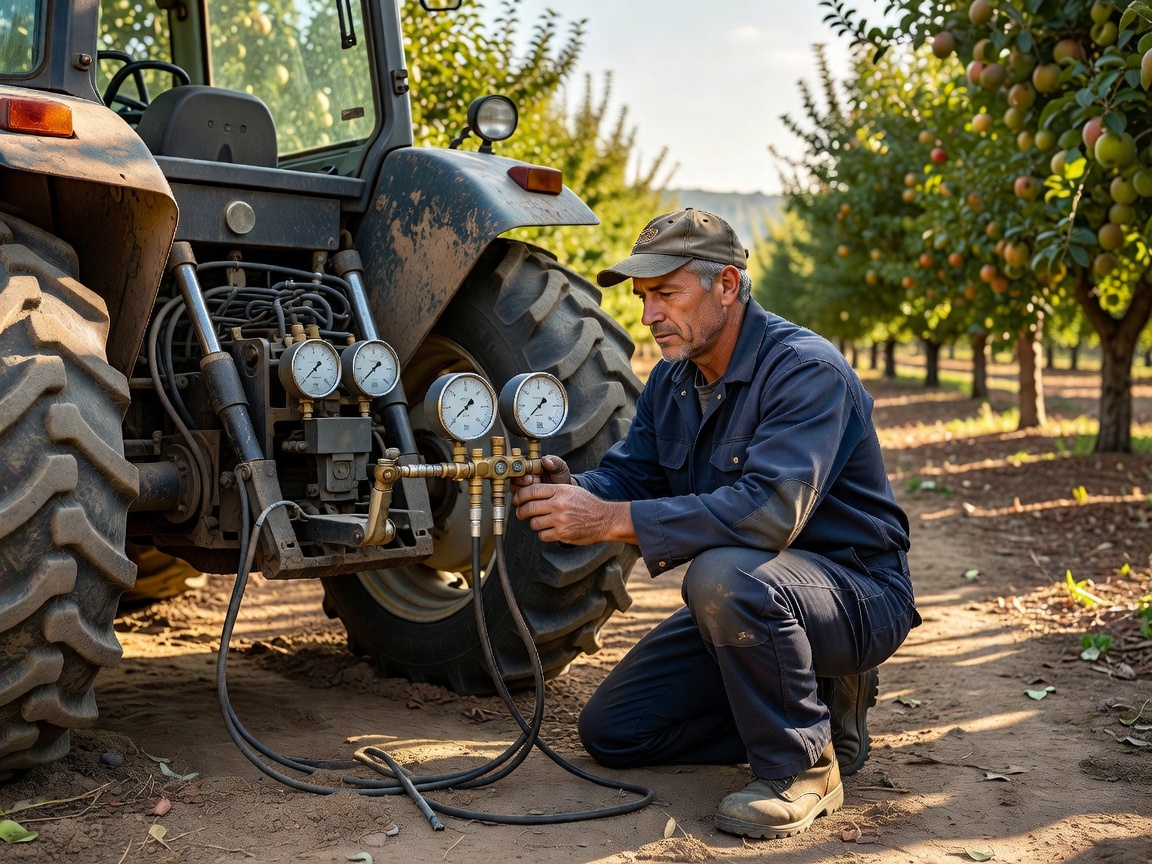
Systematic Condition Assessment & Diagnostics
Inspections generate actionable technical data. By methodically logging backlash, pump relief thresholds, tire sidewall casing integrity, and spray droplet uniformity, workshop managers eliminate guesswork from machinery allocation.
Inspection vs Maintenance vs Repair: Crucial Distinctions
In many agricultural workshops, the terms "inspection", "maintenance", and "repair" are mistakenly used as synonyms. Conflating them leads to skipped evaluations and sudden in-field failures. Here is how rigorous engineering defines each step:
- Inspection: The systematic evaluation of physical, mechanical, and electrical conditions using visual, dimensional, and diagnostic tools without altering the machine. It produces documented findings of current wear versus allowable tolerance limits. Important: Inspection alone does not improve machine condition or guarantee safety; it merely measures reality.
- Maintenance: Scheduled, proactive work intended to prevent deterioration — such as fluid exchanges, lubrication, belt retensioning, and filter replacements — carried out regardless of whether the machine has experienced an active fault.
- Repair: The corrective intervention required to restore a failed, damaged, or out-of-spec component back to operational capability through replacement, machining, or rebuild.
Key Inspection Arenas on Orchard Machines
Orchard equipment undergoes unique structural stresses. Low-slung frames clear branches, but low chassis heights make undercarriages vulnerable to hidden rock impacts, vine wire entanglement, and torque torsion from steep side-hill operations.
1. Frame, Chassis & Three-Point Linkage Fatigue
Trailed mistblowers carrying 1,500 to 2,000 liters of water transfer severe shock loads to the tractor's lower hitch links and drawbar pins during uneven row crossings. An inspection uses dye-penetrant checks or close optical review on high-stress weld fillets, the drawbar tongue, hitch pin eyes, and front axle center pivot cradles.
2. Hydraulic Lines, Hose Routing & Valve Seals
Branch strikes frequently snag hydraulic hoses running to front-mounted trimmer bars or mast lifters. Technicians examine outer rubber jackets for wire braid exposure, crimp fitting leakage, blistering, and hose rubbing points. Pressure testing verifies that pilot check valves hold cylinder loads without hydraulic drift.
3. Driveline Play, PTO Shields & Universal Joints
Constant-velocity PTO joints must be checked for radial backlash in needle bearings and rotational spline play. Safety guards and spin-free outer yellow plastic shields must be inspected for rotational freedom and anchor chain integrity to protect operators from entanglement risks.
4. Wheels, Hubs & Low-Compaction Tires
Tires in fruit orchards often run at reduced pressures to prevent root-zone soil compaction. This flexes tire sidewalls heavily. Inspections check for bead rim slipping, sidewall cracking, lug separation, and wheel stud torque tension. Wheel hub bearings are checked for end-play and seal leakage.
5. Sprayer Calibration & Nozzle Distribution
Air-blast sprayers must deliver uniform droplet patterns across the full tree canopy profile. Technical inspections test individual nozzle output flow rates using collection graduated cylinders. If individual nozzle outputs vary by more than 5% from manufacturer ratings, replacement is flagged. Fan clutch operation, air straightening vane angles, and pressure gauge calibration are formally logged.
Inspection Documentation & Fleet Records
An unrecorded inspection is nearly useless. When a mechanic checks steering ball joint play and notes "minor wear", that data point needs to be logged with date and operational hours.
By comparing consecutive inspection sheets, fleet managers identify whether a component is deteriorating at normal baseline wear rates or experiencing accelerated failure due to misaligned implements or operator abuse.
Benefits of Formal Inspections
- Catches micro-fissures in drawbars and hitch assemblies before separation.
- Ensures strict regulatory compliance for orchard chemical spray delivery.
- Provides concrete data for equipment trade-in valuation and resale.
- Reduces operator liability risks by documenting mechanical audits.
Common Pitfalls to Avoid
- Assuming an inspection constitutes a repair or warranty of zero failures.
- Failing to record quantitative measurements (e.g., logging "OK" instead of "0.4mm play").
- Conducting purely superficial walk-arounds without load-testing hydraulic circuits.
- Ignoring safety shield wear on the assumption that "it's just a cover."
Practical Inspection Audit Checklist
- ● Hydraulics Audit: Pressurize circuit to relief point; inspect all hose crimps, manifold blocks, and cylinder gland seals for seepage.
- ● Braking Linkages: Measure brake pedal free travel; verify differential lock release and emergency park brake cable tension.
- ● Steering & Front Axle: Jack front axle; check wheel bearing play, steering tie-rod ball joints, and center trunnion pin clearance.
- ● Safety Devices: Test Roll-Over Protective Structure (ROPS) mounting torque, seatbelt retractor lock, and PTO master emergency stop switch.
- ● Sprayer Unit: Verify pressure gauge accuracy against a certified master gauge at 5, 10, and 15 bar operating settings.
Good For
Growers preparing for third-party agricultural quality certifications, operations buying or selling used orchard tractors, and fleet managers responsible for seasonal worker safety during high-tempo pruning and harvesting periods.
What to Know
A completed inspection checklist does not guarantee that a mechanical part will not fail under unpredictable field loads. Metal fatigue can develop beneath surface paint, and hydraulic valves can ingest microscopic debris at any time. Inspections significantly reduce risk profiles, but they are a tool of probability, not an absolute warranty.